How Title Tags Affect Rankings
Open a browser tab right now and look at the very top of the window. That small line of text sitting in the tab, the one that tells you what page you are on, is a title tag. Most people never think about it. Most website owners set it once when they build their site and never touch it again. And yet, that tiny piece of text carries more weight in search engine optimization than almost any other single element on a webpage.
Title tags are the first thing Google reads when it crawls a page. They are the headline that appears as a clickable blue link in search results. They are what shows up when someone shares a page on social media without adding their own caption. They tell both search engines and human beings what a page is about before anyone has read a single word of the actual content. For a business in San Francisco trying to rank for competitive local keywords, or a startup in Palo Alto working to get found by the right audience, a well-written title tag can quietly be the difference between a page that gets traffic and one that sits invisible on page four.
What makes this worth paying close attention to is that most businesses get title tags wrong in one of the same three ways, and fixing them rarely requires rebuilding anything. It just requires knowing what actually works.
What Google Does With Your Title Tag
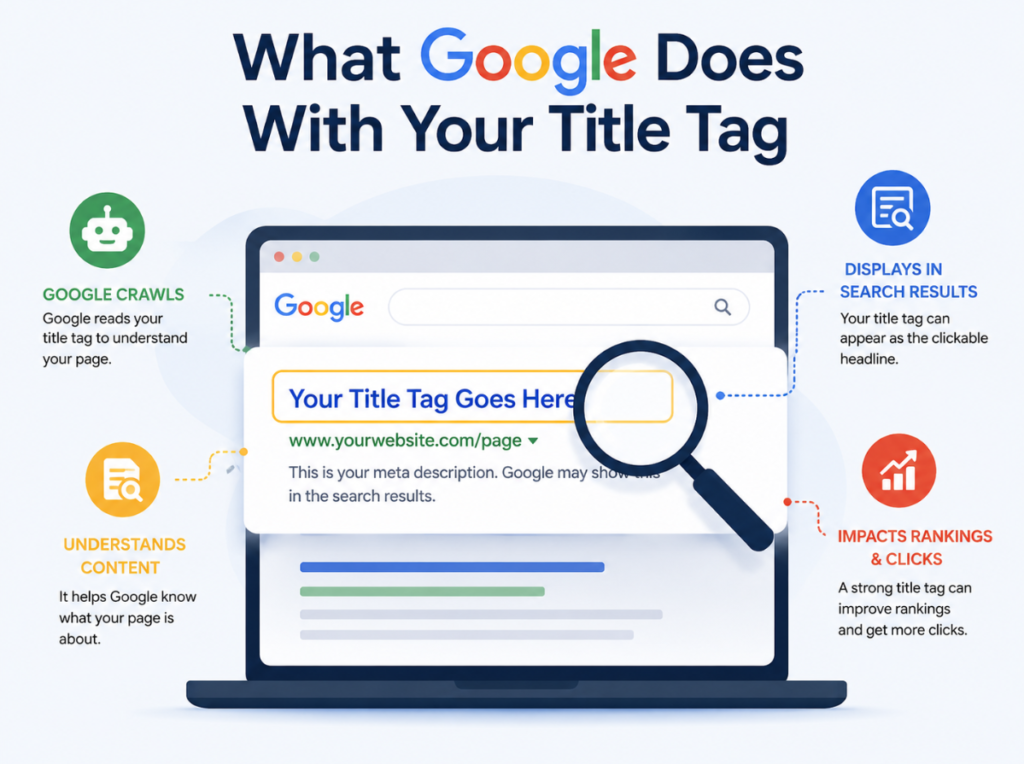
Let’s start with how Google actually uses title tags, because this shapes every decision you make when writing them. Google reads the title tag to understand what a page is about and uses that understanding to match the page against relevant searches. When someone types “digital marketing services San Jose” into Google, the algorithm scans millions of pages and tries to identify which ones are genuinely about that topic. Pages with that phrase or close variations in their title tag get a relevance signal that pages without it do not.
This does not mean stuffing keywords into your title tag will send your rankings through the roof. Google is far more sophisticated than that now. What it means is that your title tag needs to clearly and accurately reflect the content of the page while including the primary keyword or phrase that the page is intended to rank for. The keyword needs to be there because it belongs there, not because someone crammed it in to try to trick the algorithm.
One thing that surprises many business owners is that Google does not always use the title tag you write. If Google determines that your title tag does not accurately describe the page, or that a different piece of text on the page would serve searchers better, it will rewrite your title in the search results. This does not mean your original tag is irrelevant. It still influences how the page is indexed and ranked. But the displayed title may look different from what you wrote. The best way to prevent unwanted rewrites is to write titles that are accurate, clear, and directly connected to the page content.
Title tags also influence click-through rate, which feeds back into rankings over time. When a page appears in search results and more people click on it than on competing pages, Google interprets that as a signal that the result is satisfying. A title tag that is compelling, specific, and relevant to the search query earns more clicks. More clicks send a positive signal. That signal contributes to ranking improvement over time. The loop is slow but real, and it means your title tag does double duty as both an SEO element and a piece of marketing copy.
The Anatomy of a Title Tag That Actually Works
There is no single template that produces a perfect title tag every time, but there are consistent principles that separate high-performing titles from weak ones. Understanding each principle gives you a framework for writing title tags that work across different types of pages.
Length is the first variable most SEO experts focus on. Google displays roughly fifty to sixty characters of a title tag before cutting it off in search results. If your title is longer than that, it gets truncated with an ellipsis, and the reader may miss the most important part. Keeping titles within that range is not a hard rule, but consistently going over it means your titles are being cut off for most users, which reduces the effectiveness of the carefully chosen words at the end. Front-loading the most important information protects against truncation and also aligns with how people read, scanning the beginning of a line before the end.
Keyword placement matters. The primary keyword for a page should appear early in the title tag when possible. “SEO Consultants in San Francisco” is stronger than “Professional Services You Can Count On from Our San Francisco SEO Consultants” not just because it is shorter, but because the most relevant terms appear first. Search engines and users both pay more attention to the beginning of a title.
Specificity outperforms vagueness every time. A title like “Digital Marketing Agency in Palo Alto” tells a searcher exactly what they are getting. A title like “We Help Businesses Grow Online” tells them almost nothing. The specific version matches real searches people make. The vague version could apply to thousands of different businesses and matches almost nothing people actually type into a search bar.
Brand name placement is a point of debate among SEO professionals. Most agree that including your brand name in the title tag is worth doing, particularly for branded search visibility and for building recognition when your pages appear repeatedly in results. The question is whether it goes at the beginning or the end. For most informational and service pages, putting the keyword first and the brand name at the end after a separator makes more sense. For your homepage, leading with the brand name is appropriate because the homepage is the most brand-focused page on the site.
Here are the key principles for writing title tags that support both rankings and click-through rates:
- Keep the title between fifty and sixty characters so it displays in full in search results without truncation
- Place the primary keyword as close to the beginning of the title as possible without making it sound unnatural
- Write for the human reader first, since a title that earns clicks also earns ranking signals over time
- Include your city or service area for local pages, particularly if you serve specific markets like San Jose, Palo Alto, or San Francisco
- Avoid writing the same or nearly identical title tags for multiple pages, since duplicate titles confuse search engines about which page to rank for a given query
- Use a separator like a pipe or hyphen to divide the primary topic from the brand name when both are included
- Review your title tags when Google rewrites them in Search Console, since rewrites often reveal that the original title was unclear or mismatched to the page content
Why Title Tags Are Part of a Bigger SEO Picture
Title tags are not a standalone fix. They work best when they are part of a broader search engine optimization strategy that includes strong page content, good technical performance, proper internal linking, and credible backlinks. Fixing your title tags on a page with thin or irrelevant content will improve your click-through rate from search results, but Google will not rank that page well in competitive searches no matter how perfectly written the title is. The title is a door. The content is what people find when they walk through it.
This is one reason why good digital marketing strategy treats on-page SEO as a system rather than a checklist of individual fixes. Title tags, meta descriptions, headings, page copy, image alt text, and internal links all send signals to search engines about what a page is about and how much value it provides to users. When these elements are aligned with each other and with a genuine piece of helpful, well-written content, the combined effect on rankings is much stronger than any single element working alone.
For businesses working with a digital agency or professional marketing consultant, title tags are often one of the first things an SEO audit will flag because they are easy to assess and relatively quick to fix. A thorough audit might reveal dozens of pages with missing titles, duplicate titles, titles that are too long, or titles that do not include any relevant keywords. Fixing all of these in one pass can produce measurable improvements in organic traffic and online visibility within a few weeks, especially for pages that were already ranking on page two or three and just needed a nudge.
ViewRanking Digital Marketing Agency works with businesses across San Francisco, Palo Alto, and San Jose on exactly this kind of connected approach to search engine optimization, where on-page elements like title tags are improved as part of a strategy that also addresses content quality, local SEO, and technical performance together.
Title tags are small. The effort required to fix them is modest. And the long-term impact on your rankings, your click-through rate, and your overall marketing success is larger than most people expect until they actually see it happen. That combination makes them one of the highest-return investments available in professional SEO services for businesses at any stage of growth.